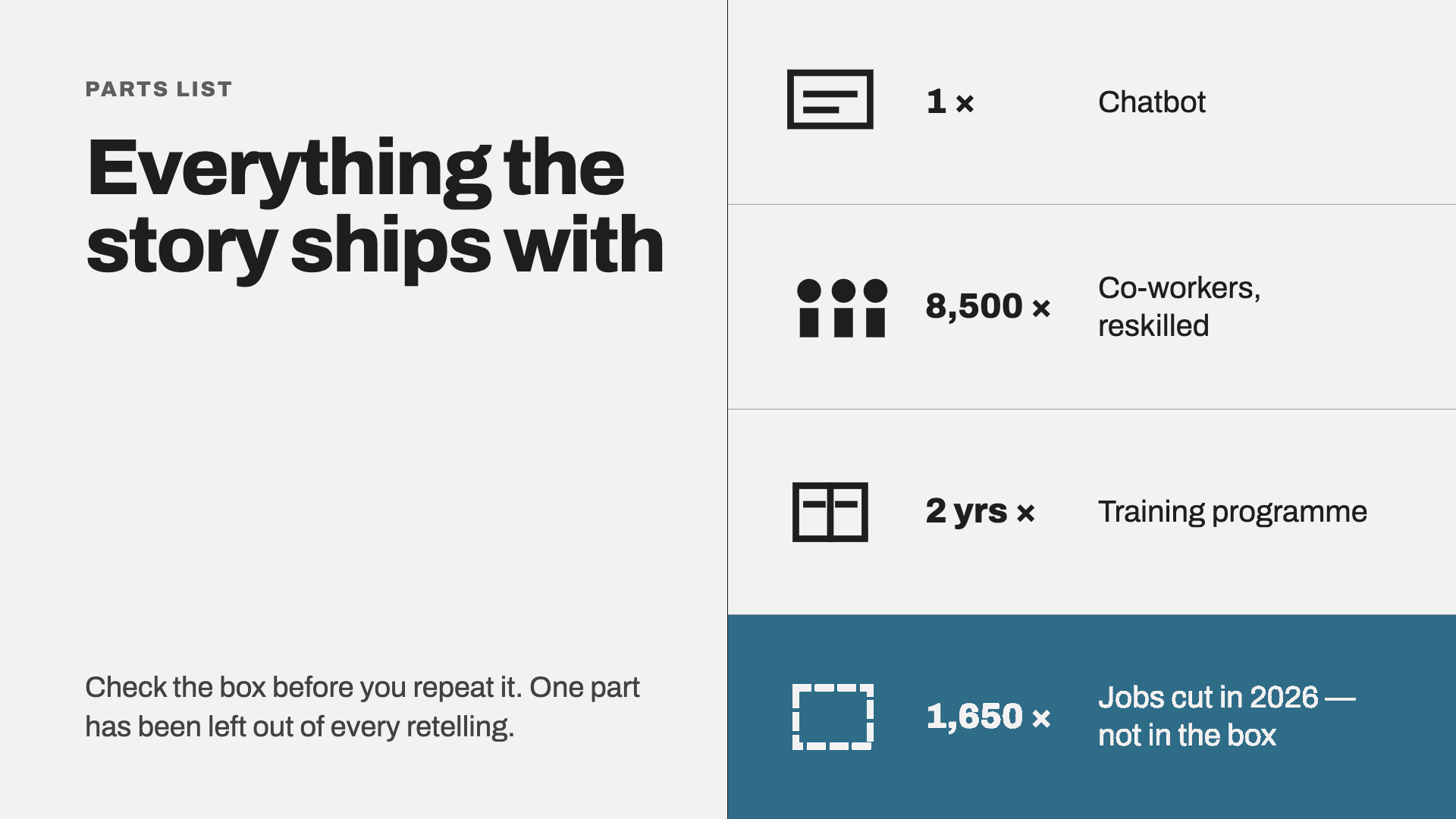
You've probably heard some version of this one already. "IKEA didn't lay off 8,500 workers when AI came for their jobs. They retrained them instead, and made a billion dollars doing it." It shows up in slide decks and LinkedIn posts as a go-to counterexample whenever someone brings up AI and job loss, proof that it doesn't have to go the way everyone assumes.
I heard my own version of it secondhand, on a call a few weeks ago: "IKEA reduced customer service by something like 80 percent and made about a billion dollars extra." Rounded, confident, and, it turns out, not quite right in either direction.
Here's what I found.
It Begins With Covid
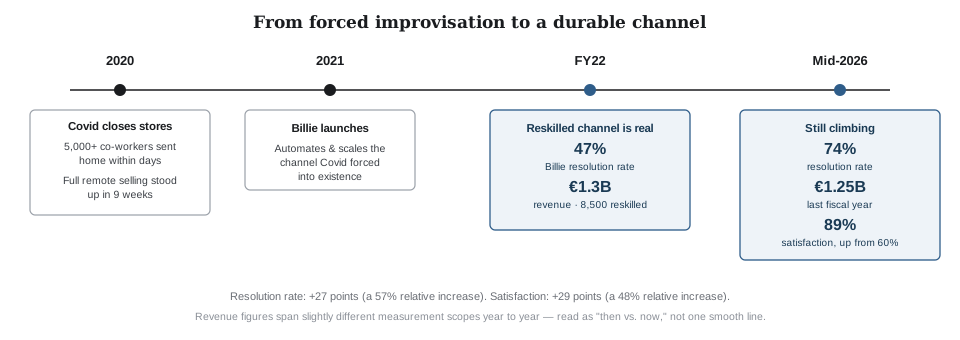
Start a year earlier than most retellings do. When Covid lockdowns closed IKEA's stores in 2020, Ingka Group, the largest of IKEA's franchised retailers and the company behind this whole story, sent more than 5,000 customer support co-workers home within days [5]. Contact volume spiked two to three times normal [5]. Within nine weeks, most countries were running full remote sales sessions, not just phone support, with what the company itself called "a significant impact on sales performance" [5]. Pernilla Jöne, Deputy Customer Support Centre Manager at Ingka Group, described standing up an entire remote customer-service platform in France and Germany "in a matter of days, something that usually takes six months" [5].
That's the real starting point. Billie, the AI chatbot at the center of this story, wasn't a standalone decision made in a vacuum. It launched in 2021 to automate and scale a remote-service channel the pandemic had already forced into existence a year earlier.
Over its first two years, Billie resolved about 47 percent of the roughly 3.2 million interactions it handled, saving the company around €13 million [1]. That's the number that usually gets rounded up to "80 percent reduced." It wasn't.
The more interesting number is what happened to the other 53 percent, and to the people who used to handle it by hand.
Instead of treating the unresolved majority as a chatbot failure, Ingka read it as a demand signal. People weren't calling to check if a sofa was in stock. They were calling because they wanted to know if it would look good in their living room, a question a bot can't really answer [4]. So Ingka took the 8,500 call-center workers whose jobs the chatbot was displacing and reskilled them into remote interior design consultants, through a training program over about two years, not a one-off orientation [1][2].
That training was blended, not a webinar series: in-person and online classes, plus actual field trips into physical stores [2]. The curriculum covered IKEA's digital room-planning tools, product-specific tracks like a dedicated "kitchen school", and material knowledge so a consultant can describe and recommend fabrics or finishes a customer can't touch through a screen [2]. A meaningful part of it wasn't technical at all: learning to ask the right questions in a planning session, starting with basics like measurements and color preferences and moving into more consultative territory, "What is not working in the room?" "How are you feeling?" [2].
Fortune's reporting has a good example of what that training actually produces: a customer called about a custom-cut countertop with an oddly angled hexagonal layout, the kind of problem a bot can't reason through. Madeleine Barr, a design consultant, worked it out anyway. "It's a lot of angles," she said [2].
It worked. By the end of FY22, that reskilled channel was generating €1.3 billion, about 3.3 percent of Ingka's total sales [1]. Spread across the 8,500 reskilled workers, that's roughly €153,000 in channel revenue per person, a rough average, not an individual productivity claim, but a useful sense of scale for what "a new revenue channel" actually meant in practice [1]. And it kept working: as of Fortune's reporting this past July, Billie's resolution rate has climbed to 74 percent (up 27 points, a 57 percent relative increase), the remote design channel pulled in €1.25 billion last fiscal year across 24 centers in 31 countries, and customer satisfaction is up to 89 percent, from 60 percent before Billie existed (up 29 points, a 48 percent relative increase) [2].
What they got right
Three things here deserve real credit.
They treated the chatbot's failure rate as market research instead of something to patch or hide [4].
They funded actual infrastructure for the transition, which took two years. That's not a symbolic reassignment [1][2].
And the results held up. Resolution rate, revenue, and satisfaction all kept climbing for years after the press cycle moved on, which is rarer than the initial launch itself [2].
That's the real story, and it's a genuinely good one. But wait, there's more!
The part that gets left out
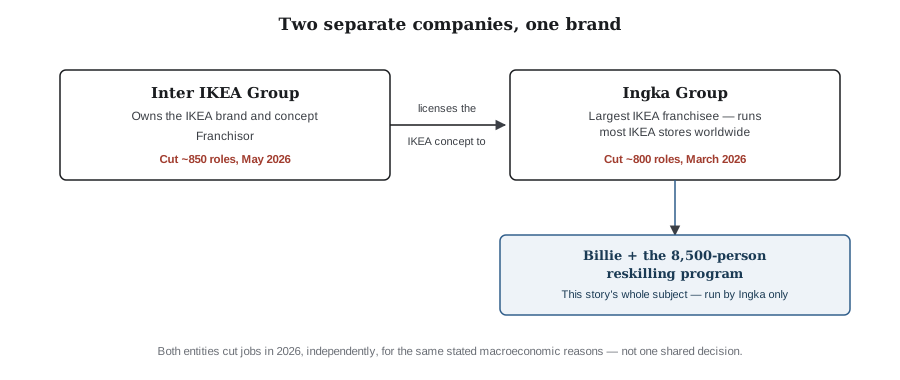
In March 2026, Ingka Group cut around 800 corporate and office-based roles, mostly at its Swedish offices and Dutch headquarters. In May, Inter IKEA, the separate company that owns the IKEA brand, cut around 850 more, globally.
Combined, about 1,650 jobs: roughly 800 at Ingka, a company of some 162,000 people, and 850 at Inter IKEA, which has around 27,500. Both describe the reasons as macroeconomic, not AI: two years of declining sales, US tariffs, and a business that, in the words of Inter IKEA CFO Henrik Elm, had "grown a bit too complex and too fragmented" [3]. Two different companies, cutting independently, not one shared decision, worth keeping straight given how easily "IKEA" collapses both into a single actor. That holds up in Ingka's own financials, not just its press language: group revenue peaked at €44.3 billion in FY23 [6], then fell to €41.8 billion the following year [8] and stayed below that level in FY25.
It's worth asking how much of that also reflects pandemic-era hiring finally normalizing, rather than purely fresh 2026 distress. Ingka's own reporting shows headcount climbed through the remote-selling buildout, from about 166,000 co-workers in FY20, the year it recruited 48,700 people, to somewhere around 174,000-177,000 by FY22, then fell to an average of roughly 162,000 by FY24, well before the 1,650 cuts named above [5][7][8]. Some of that swing is genuinely hard to untangle cleanly, Ingka also exited Russia in 2022 and changed its reporting scope the same year, but the shape of it suggests the named 2026 cuts are the visible tail of a longer contraction, not an isolated new event.
None of the 8,500 reskilled design consultants appear to have been among these cuts. They hit corporate functions, not stores, warehouses, or customer-facing roles [3]. That specific claim, that the people Billie displaced were protected, still holds.
But one month before the March cuts started, Ulrika Biesèrt, Ingka Group's Global People & Culture Manager, wrote that "people have been at the heart of IKEA for over 80 years" [3]. And when Fortune asked CDO Parag Parekh, the executive behind the Billie program, whether more layoffs were coming, he wouldn't rule it out, but said any future cuts would more likely come from macroeconomic pressure than from AI [2].
What actually connects all of this, the pandemic scramble, the chatbot, the reskilling, the recent cuts, isn't one decision made once and left alone. It's a company that kept adjusting its labor strategy as conditions changed, under real pressure each time. Covid forced a fast, improvised move to remote service. Billie then automated and scaled what that improvisation had built. The reskilling program kept getting funded and re-evaluated as Billie's resolution rate climbed from 47 to 74 percent. The 2026 cuts show the same company still adjusting, this time to a different set of pressures, in a different part of the business. This isn't a story with an ending. It's a company that hasn't stopped evolving its approach to labor, with AI as one input among several, not the whole plot.
What would you do?
So here's the actual question worth asking. The question isn't whether IKEA got it right. They did, for the people in Billie's path. It's this: when's the last time anyone checked whether your own organization's AI success story still holds?
References
- Ingka Group Newsroom, "AI and Remote Selling bring IKEA design expertise to the many," 2023-06-29. ingka.com — original Billie figures: 47% resolution, 3.2M interactions, ~€13M savings, 8,500 reskilled, €1.3B FY22 remote-sales revenue, quotes from CDO Parag Parekh and People & Culture Manager Ulrika Biesèrt.
- Fortune, "Inside Ikea's big bet on humans in the age of AI," 2026-07-30. fortune.com — updated figures: 74% resolution rate, €1.25B/$1.37B remote-sales revenue last fiscal year, 89% satisfaction (up from 60%), training duration, Madeleine Barr anecdote, CDO Parag Parekh on record not ruling out future layoffs.
- employerbranding.news, "IKEA's AI Reskilling Case, Reassessed After 2026 Layoffs." employerbranding.news — March 2026 Ingka Group cuts (~800 roles), May 2026 Inter IKEA cuts (~850 roles), Chief People & Culture Officer and CFO quotes, confirms reskilled workforce untouched.
- CIO.com, Alberto Bellé, 2026-06-09. cio.com — framing on the unresolved 53% of Billie inquiries as a demand signal rather than a failure.
- Ingka Group, "Annual Summary & Sustainability Report FY20." ingka.com — primary source for the 2020 pandemic-driven remote-selling buildout, the Pernilla Jöne quote, 5,000+ co-workers sent home within days, 166,350 total co-workers, 48,700 people recruited that year.
- Ingka Group, "Annual Summary and Sustainability Report FY23." ingka.com — source for FY23 total revenue (€44.3B, the post-pandemic peak referenced in the 2026 layoffs section).
- Ingka Group, "Annual Summary and Sustainability Report FY22." ingka.com — source for FY22 co-worker headcount (~174,225-177,192; the report itself flags a reporting-scope caveat excluding Germany, Ingka Centres, and Russia/Ukraine that year).
- Ingka Group, "Annual Summary and Sustainability Report FY24." ingka.com — source for FY24 average co-worker headcount (162,293), FY24 total revenue (€41.8B).