Imagine for a moment that you're part of a marketing team on a video call (with no cameras on) and the team leader asks "Any objections?" to a decision that's about to be made. After months of planning, reviews, and approvals this is the final "Let's do it!" check. Everyone is quiet because that's what's normal. Everyone assumes good work has been done. That it's time to launch and that you're ready for the usual changes that might follow. Everyone assumes someone else has already thought about the AI used on this project, that someone further up the chain is "AI aware" and would have flagged it if there were a problem. After all, AI was used for a minor change and as usual it proved helpful. Everyone is under pressure to deliver, and staying quiet is easier than being the one who slows down another slam dunk marketing campaign. The campaign is approved for launch.
After launch, all hell breaks loose.
While a formal process was in place to make sure the campaign was in good order, that last minute AI related change combined with a desire to "get it launched" resulted in an uprising against your company. Your campaign matched the language of abusers for a historical period in your country. It was as if someone took the enemies' position and advocated for them in this marketing campaign on a societal and political level.
Your team and your leaders agreed on a last minute change helped by AI. They also agreed to launch the campaign on the same day as this historical event. It was the worst of both worlds. It was one of the most damaging marketing controversies in Korean corporate history.
Here's how it happened at Starbucks Korea.
For awareness, Starbucks Korea isn't run directly by Starbucks Corporation in the US. It operates under license, run by E-Mart, which is managed largely by its parent conglomerate, the Shinsegae Group [18]. That distinction matters for how this played out, and for who ultimately had to answer for it.
In December of 2025, Starbucks Korea's marketing team, the same team that runs the brand's e-Frequency loyalty promotions, was sitting down to plan ahead for 2026. But a prior loyalty promotion got in their way first. Between October and December 2025, Starbucks Korea had given away approximately 393,548 humidifiers as a free gift through its Winter Frequency loyalty program. This was not a product they sold. Rather, it was a promotional item tied to that campaign [1]. In January 2026, a battery fire risk forced a full recall of every unit, not just the defective ones. It was a real safety issue, and it was handled well: fast, proactive, voluntary, and with compensation for every customer who returned theirs [2].
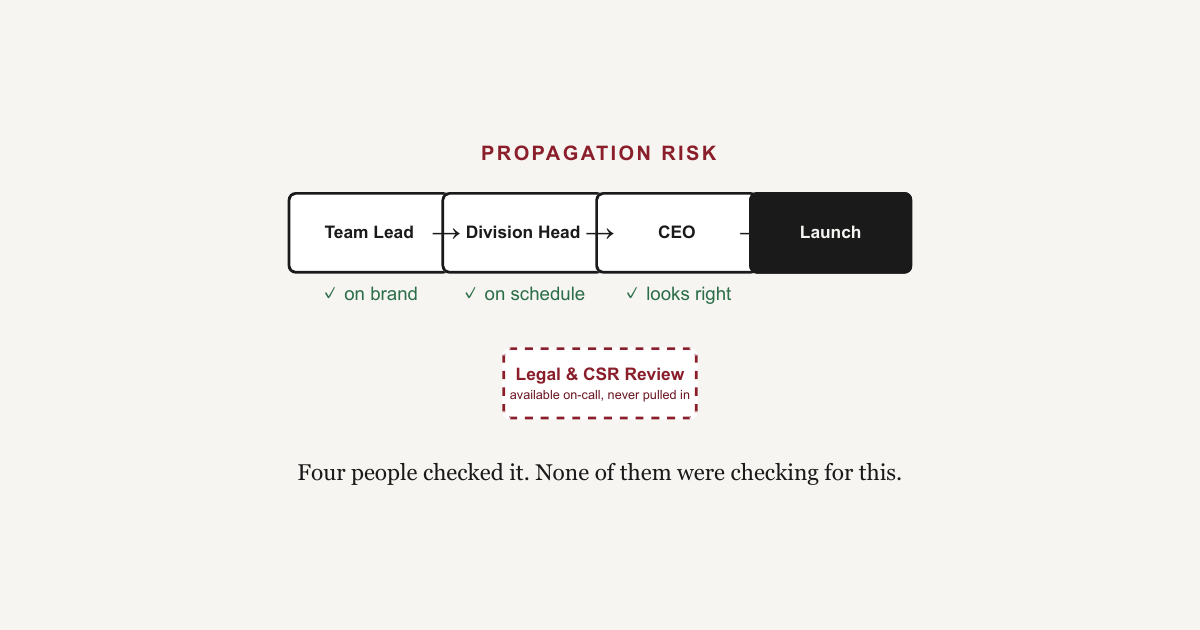
That recall is what created the time pressure. It forced the team to postpone their planned Summer Frequency loyalty campaign in late March, which meant they suddenly needed a replacement item, fast, for the next promotional window, "Buddy Week." They picked "Tank," one of their bestselling tumblers, and built a campaign around it called "Tank Day" [3]. Once the team regrouped from the recall priority, they finalized the campaign and its May 18 launch date. The campaign workflow included a four-stage, three-day sign-off that took place in late April. It included a team lead, a division head, and the CEO [4]. Legal and CSR (Corporate Social Responsibility) weren't a mandatory gate everyone's work ran through, they were specialist functions available on-call if someone flagged a risk worth escalating. Under the time pressure to move fast, nobody in the workflow flagged any risks, so neither specialist function was ever pulled in [6]. No one considered what the May 18 date meant.
On May 8, ten days before launch, with the campaign and its date already locked, the marketing team decides a slogan is needed. They aren't starting from a blank page, they're trying to match the rhyme of an earlier tumbler campaign's slogan, "가방에 쏙" ("tucks neatly into your bag"), so they turn to generative AI for something with the same rhythm. AI is used. The phrase "bang on the desk" is chosen because it rhymed [5]. That phrase then goes through the same team-lead-to-CEO workflow as everything else, four people, the normal sign-off, not a shortcut. Legal and CSR, the same on-call review nobody thought to pull in for the date, weren't triggered for the slogan either, never part of the workflow at any point. Four separate people looked at "bang on the desk" on its way to launch. None of them made the connection [6].
That phrase "bang on the desk" closely echoed the police's own cover story from January 1987, when Seoul National University student Park Jong-chul died during police interrogation under South Korea's military government at the time. Investigators initially claimed he died of shock after they "hit the desk and he gasped," a transparent lie covering up torture. The truth came out, and Park's death became one of the sparks for the June 1987 Democratic Uprising that forced the regime to accept direct presidential elections [7]. That's a second, distinct historical wound layered under the same phrase, seven years and a different kind of state violence apart from the Gwangju Uprising, but part of the same democratization story, and part of why May 18 carries the weight it does for the Korean population. The bigger reason May 18 was a day of reflection was the 1980 Gwangju Uprising itself, a major event in Korean history. In May 1980, student-led protests against a military coup and newly imposed martial law grew into a citywide uprising in Gwangju. The government sent army paratroopers to put it down, and soldiers used brutal, indiscriminate force against civilians, killing and injuring protesters and bystanders alike. Citizens armed themselves and held the city for several days before the military retook it in a violent final assault. Official death tolls remain disputed, CNN reports more than 100 killed, other estimates run considerably higher, and are widely believed to undercount the real number. The uprising became a foundational event in South Korea's transition to democracy, and May 18 is now a national day of remembrance [8].
Two separate historical wounds, one campaign, and a slogan that four separate reviewers looked at and never recognized.
The backlash was immediate. Starbucks Korea apologized that same day, and Starbucks Corporation followed shortly after with its own apology and an announcement that it was investigating what had gone wrong [18]. The next day, May 19, Shinsegae Group fired the CEO of Starbucks Korea, citing "inappropriate marketing" [18].
What this mistake cost
The mistake so far has roughly cost E-Mart stock 182 million US dollars in market value [9]. Analysts have already cut their price target on E-Mart stock by 28%, and separately slashed their 2026 revenue and operating profit forecasts for the company [10]. This is followed by additional evidence that in the first week, payment volume was down by about 5.7 million dollars, and a month later that cumulative loss is around 13.5 million dollars [11].
Beyond the CEO, Shinsegae Group, the same entity that fired him, also removed the executive who oversaw the campaign's planning and operations, and opened disciplinary proceedings for the marketing staff involved [12]. All 2,000+ Starbucks stores closed nationwide and underwent historical retraining [12].
The risk is still rising
While E-Mart has attempted to address the errors and be accountable for the Tank Day campaign, it doesn't work that easily like it does in the US when insult and defamation are on the table. In Korea, unlike in the US, insult and defamation are criminal offenses, not civil matters, so a formal complaint here can trigger an actual police investigation [13]. A civic group filed a criminal complaint specifically against Shinsegae Group Chairman Chung Yong-jin, alleging the campaign insulted honorees of the May 18 Democratic Movement [14]. Police first sought a warrant back in June covering three charges at once, insult, defamation, and violation of Korea's Special Act on the May 18 Democratic Movement, but prosecutors rejected it, ruling only the insult charge was sustainable [15]. On August 5, 2026, with a narrower warrant limited to that insult charge, police raided the Starbucks Korea headquarters and the former CEO's personal residence, going through phones, messenger logs, and internal records to determine whether there was intent behind the campaign [16].
See no evil
While both AI and a marketing team failed at a small level, the bigger failure is a desire to get work done quickly. Picture the pressure in that room: a costly recall had just embarrassed the brand, a promotional calendar slot was sitting empty, and leadership wanted a quick, clean win to prove the loyalty program was back on track. Nobody had to say "cut corners," the calendar did that on its own. A common theme in today's time-pressured, AI-focused world.
Two candidates seem to bubble up to the top of this organizational dysfunction gone horribly wrong.
Propagation Risk
This one isn't about a skipped gate, the slogan actually went through four reviewers on its way to launch. It's about what those four people were actually checking for. Each of them was reviewing the campaign the way they always review a campaign, is it on brand, is it on schedule, does it look right, not whether it carried a specific historical reference none of them had the specialized training to recognize. Legal and CSR, the review that exists specifically to catch that kind of thing, was never part of the workflow at all. Basically, a normal review answered a question nobody actually asked it to answer, and everyone downstream assumed that because it had been reviewed, it had been checked for the thing that mattered.
Diffusion of Responsibility
Four different people had "bang on the desk" in front of them before it launched, a team lead, a division head, and the CEO among them. That's not an assumption anymore, it's confirmed. And still nobody caught it. That's a harder problem than "someone skipped a step." When four people in sequence all pass something along without incident, each one reasonably reads the others' silence as confirmation that it's fine, the same silence problem this whole piece opened with, just running inside the company instead of on a video call. Industry commentary on this exact case makes the point directly: pinning blame on the one staffer who first drafted the phrase risks obscuring the organization's actual risk management failure [17]. The real governance question underneath all of it isn't whether anyone checked, they did, four times. It's who owns recognizing that a decision touches a kind of risk none of those four reviewers were positioned to see, and pulling in someone who was.
What Was Missing Inside Starbucks Korea?
Many corporate workflows deliberately route around slower dependencies when they don't have to use them, because moving fast is worth carrying a little risk. Skipping legal and CSR review wasn't laziness here, it was a bet, and an easy one to make, because of a bias that runs through almost every fast-moving team: if it's worked the last ten times, it'll probably work this time too. Pulling either review in would have added real time to an already compressed schedule, and skipping them meant the campaign stayed on track. On its face, that bet looked fine, probably felt like another slam dunk campaign coming together under pressure, the same kind of trade-off every team in every organization I've worked at or helped makes routinely to get work out the door.
But here we are today. The same bias, the same shortcut that usually saves time and money, is exactly what turned a minor slogan change into a multi-million dollar problem and a CEO's job.
With the information available today, what is clear is there was no way, at the corporate level, to catch a late change that materially shifted the risk profile, regardless of whether AI or a person made it. A team can move fast on its own and still be operating inside a corporate workflow that has no mechanism to pull a change like that back in for a quick review before it goes out.
Making "AI was used" the trigger for that review would miss the point, and it would build a kind of bureaucracy people learn to route around soon enough. The trigger has to be the risk itself: does this change touch public-facing language, sensitive data, or something with cultural or regulatory exposure? If so, it goes back through the right reviewer, whoever or whatever produced it. That's a RACI question that predates AI entirely, and it should have already been answered before AI ever entered the picture.
A corporate workflow that checks once is a formality, not governance. Real governance is designed into the way people actually work, and it's triggered by what actually changed, not by which tool touched it last.
What would you do?
If you were on that video call today (without your camera turned on) and your team leader asked the question "Are there any objections?" what would you say?
Would you raise a concern that a late change, AI-assisted or not, was never tested for risk?
Would you suggest that a change is needed in the corporate workflow so that moving fast doesn't mean skipping review?
Perhaps you're silent along with your colleagues (who all have their cameras turned off during the call)?
References
- Shinsegae Group Newsroom, "스타벅스 '가습기' 자발적 리콜 진행." shinsegaegroupnewsroom.com — Winter Frequency humidifier giveaway, 393,548 units, October to December 2025.
- Korea Times, "Starbucks Korea to recall humidifiers over fire concerns" (2026-01-30), koreatimes.co.kr; Seoul Economic Daily, "Starbucks Korea Recalls 390,000 Humidifiers Over Fire Risk" (2026-02-01), en.sedaily.com — the January 2026 battery-fire recall, full and voluntary, with compensation.
- News1, "5·18에 '탱크데이' 행사, 4월 중순 확정…스타벅스 조사일지 살펴보니." news1.kr — the pre-launch timeline: recall forcing Summer Frequency's postponement, the Buddy Week replacement search, "Tank" tumbler selection, and the "Tank Day" naming.
- Same as [3], plus Hankyung, "'팀장 결재 없인 불가능'…스타벅스 '탱크데이' 실무진 책임 논란." hankyung.com — the four-stage, three-day approval sequence (April 20 to 22).
- Financial News, "문구는 AI가, 출시 날짜는 우연?…스벅 '탱크데이' 관련자 무더기 징계" (2026-05-26), fnnews.com; Khan, "'텀블러 홍보 문구, AI에 물어 작성'…연매출 3조 스벅의 해명" (2026-05-26), khan.co.kr — Shinsegae's internal investigation: the phrase was AI-sourced to match the rhyme of an earlier campaign's slogan "가방에 쏙," and passed through all four stages of the normal team-lead-to-CEO workflow without anyone recognizing the historical connection.
- Financial News [as in 5]; Hankyung [as in 4] — CSR and legal review skipped specifically for speed at every stage, per Shinsegae's internal investigation, distinct from the normal team-lead-to-CEO workflow the phrase did pass through.
- Newsis, "'책상을 탁 치니 억 하고'…李대통령 언급한 '박종철 고문치사' 사건은" (2026-05-20). newsis.com — the phrase's echo of the 1987 Park Jong-chul police statement.
- Wikipedia, "Gwangju Uprising." en.wikipedia.org — background on the May 1980 event.
- StarNews, "'5·18 탱크데이' 정용진 회장 사과 불구…이마트 주가 9.56% 급락, 시총 2705억 증발" (2026-05-27). starnewskorea.com — E-Mart share price and market cap loss.
- Analyst note via Daum, "이마트 목표주가 하향, 스타벅스 '탱크 데이' 논란 여파." v.daum.net — E-Mart's 28% target price cut and Heungkuk Securities' revised 2026 revenue and operating profit forecasts.
- Financial News, "스타벅스 '탱크데이' 논란 여파…결제액 85억 줄고 앱설치 23%↓(종합)" (2026-05-27), fnnews.com; Hankook Ilbo, "'탱크데이' 논란 한 달…스타벅스 결제액 200억 줄었다" (2026-07-04), hankookilbo.com — week-one and one-month payment volume declines.
- Al Jazeera, "Starbucks Korea CEO fired over promotion that evoked military crackdown" (2026-05-19), aljazeera.com — confirms Shinsegae Group Chairman Chung Yong-jin personally ordered the CEO's dismissal along with another executive; Al Jazeera, "Starbucks Korea to shut stores for history training after 'Tank Day' furore" (2026-06-15), aljazeera.com — nationwide store retraining.
- General legal-context note: insult (모욕) and defamation (명예훼손) are criminal offenses under South Korean law, unlike the US where they are civil matters.
- Korea JoongAng Daily, "Police raid Starbucks Korea headquarters over 'Tank Day' controversy" (2026-08-06). koreajoongangdaily.com — the civic group's criminal complaint against Chung Yong-jin.
- Hankyung, "경찰, 탱크데이 논란 스타벅스 첫 압수수색…모욕 혐의 적용" (2026-08-05). hankyung.com — the June warrant rejection, narrowed to the insult charge.
- Financial News, "스타벅스 본사 첫 압수수색…'탱크데이' 고의성 확인" (2026-08-05), fnnews.com — the August 5 raid on HQ and the former CEO's residence.
- Hankyung [as in 4] — the "obscures the organization's risk management failure" commentary.
- CNN, "Why police raided Starbucks Korea's headquarters," by Jessie Yeung and Yoonjung Seo (2026-08-05) — Starbucks Korea's licensing/ownership structure under E-Mart and Shinsegae Group, the same-day apology, Starbucks Corporation's separate apology and investigation announcement, and the CEO fired the day after launch (May 19) citing "inappropriate marketing."